A predatory conference is one whose business is the registration fee. It accepts almost everything, reviews almost nothing, publishes proceedings that index nowhere, and is designed end to end to look exactly like the real thing to somebody reading quickly.
They are numerous, they are well built, and they target early-career researchers and people applying from institutions where a rejected paper is more expensive. This article exists because that is the problem this whole directory sits inside.
The reliable signals
None of these is proof on its own. Two together is a pattern. Three is an answer.
A scope with no edges. "All areas of science, engineering and technology" is the most consistent signal there is. A conference that will take anything has no field, and a conference with no field has no reviewers.
A review window that cannot contain a review. Look at the gap between the submission date and the notification date. Under two weeks is not peer review. Some of these promise a decision in 48 hours and say so as a feature.
Unverifiable people. A programme committee of twenty names with no institutional pages behind them, or — this happens — names of real academics who have never agreed to be listed. Check two or three. It takes five minutes and it is the check that most often produces a clear answer.
No past edition you can find. Not the conference's own claim of a past edition: a programme, a proceedings volume, a photograph, a mention by somebody who attended.
Publication promises that name no publisher. "Scopus-indexed", "SCI-listed", "published in an international journal" with no journal named. Indexing status changes; a journal that will not name itself cannot be checked.
Unsolicited, flattering email. Especially email that praises a specific paper of yours in generic terms, invites you to be a keynote speaker or a session chair at a conference you have never heard of, or offers a discount that expires.
Urgency mechanics. Countdown timers, "only three slots left", rates that expire this week. Academic conference planning runs on six to eighteen months. Nothing about it is urgent, and manufactured urgency is a retail technique that has no reason to appear here at all.
A fee that is per paper. Combined with anything above, this is close to conclusive.
A venue that is a description rather than an address. "A luxury hotel in the city centre" is not a venue.
The signals that are not signals
A plain or dated website. Real conferences are run by academics in time they do not have. The most professional-looking conference sites in some fields belong to the least trustworthy conferences, because for them the site is the product.
A first edition. Everything established was new once. What matters is who is behind it — a first edition run by a recognised society is a different thing entirely from a first edition run by an organisation with no history.
A conference in an unexpected country. Serious conferences happen everywhere. Judging a conference by where it is held gets the wrong answer often and unfairly.
A high acceptance rate. Some legitimate workshops accept nearly everything, on purpose, because their function is to gather a small community rather than to select. The question is whether they say so.
The check that works when you are unsure
Search for the organising body, not the conference.
A predatory operation usually runs many conferences under one organisation, across unrelated fields, in different countries, on similar dates. Searching the organiser's name shows you the whole catalogue at once, and the pattern is much easier to see across twelve conferences than within one.
What we do about it here
A person reads every listing before it is published, and we decline ones we cannot verify. We do not claim that makes this directory clean — no directory can claim that honestly, and any that does is telling you something about itself.
What we can say is what we will not do. We do not sell ranking: paid promotion sits in a separate labelled region and has no effect on organic results, and the code that orders those results cannot read promotion data at all. We do not show a fee on any card. We do not run countdown timers anywhere, because timer mechanics are the cue this audience uses to identify exactly the sites this article is about.
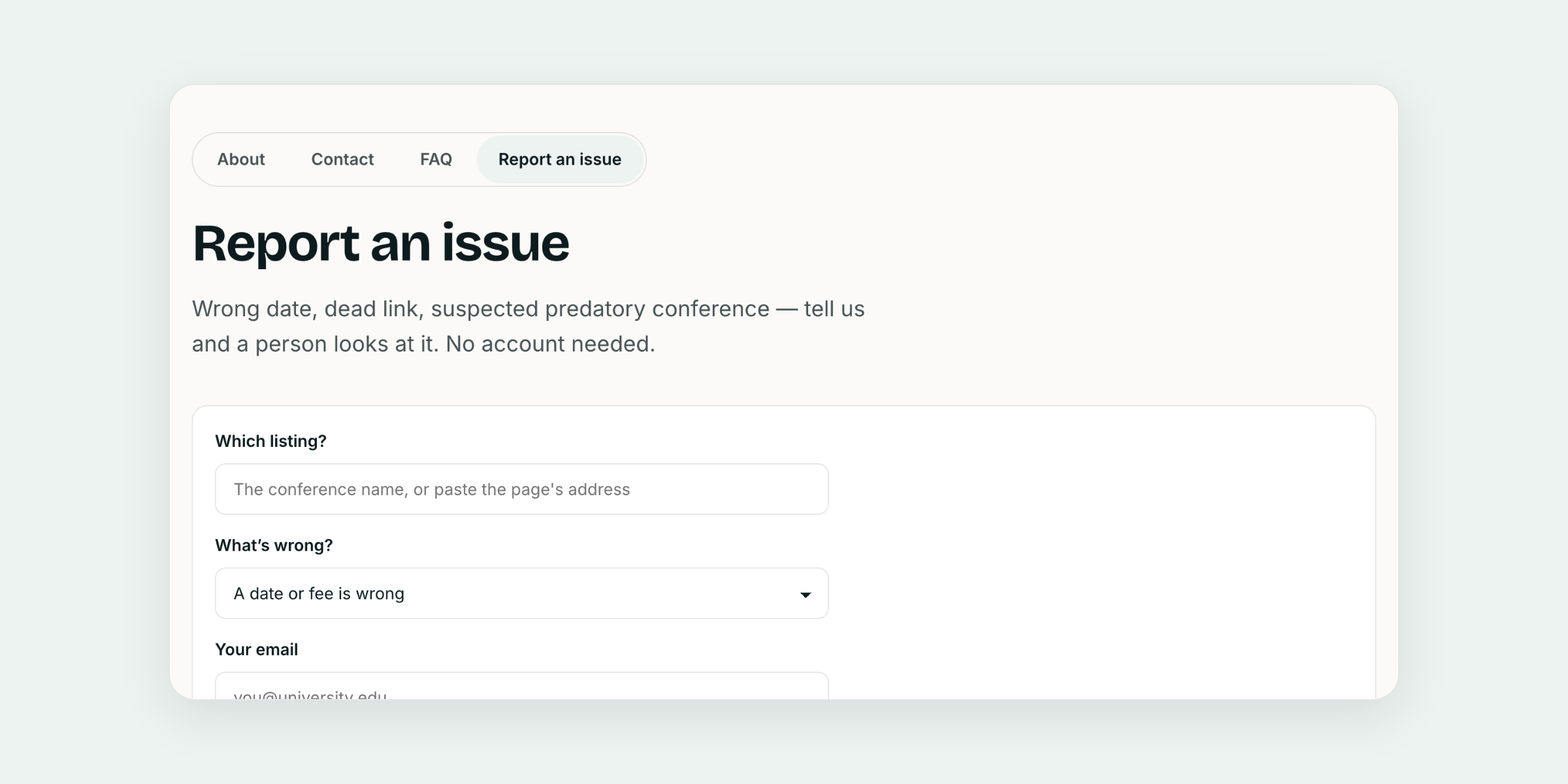
And if you find a listing here that fits the pattern above, report it from the listing. That report is read by a person.
From the directory
From the directory, read as this page loads.

30 Oct – 1 Nov 2026
Okayama, JP · Hybrid

30 Oct – 1 Nov 2026
Okayama, JP · Hybrid

30 Oct – 1 Nov 2026
Kuala Lumpur, MY · Hybrid

30 Oct – 1 Nov 2026
Kuala Lumpur, MY · Hybrid