Physical Sciences · Astronomy & Astrophysics
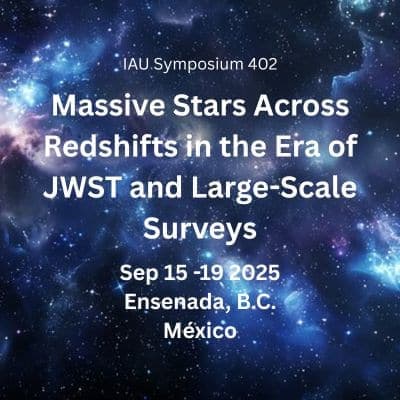
IAU Symposium 402 Massive Stars Across Redshifts in the Era of JWST and Large-Scale Surveys
Dates15–19 Sept 2025
LocationEnsenada, Mexico
SubmissionsNot listed
RegistrationClosed
FormatIn person
FieldPhysical Sciences · Astronomy & Astrophysics
OrganizerNot listed
About & call for papers
Scientific Motivation Massive stars are crucial for solving multiple cosmic puzzles. This is because they are key contributors of ionizing radiation, mechanical energy, metals, cosmic rays, and dust; and when they die, they produce neutron stars, black holes,… Read more
Scientific Motivation Massive stars are crucial for solving multiple cosmic puzzles. This is because they are key contributors of ionizing radiation, mechanical energy, metals, cosmic rays, and dust; and when they die, they produce neutron stars, black holes, and/or gravitational waves. However, many competing factors are thought to influence their observed properties and challenge our understanding of how these stars evolve and contribute to the Universe. The Massive Stars Commission (G2) of the IAU’s Stars and Stellar Physics Division regularly organizes a symposium, typically every 4 years, to present the latest research findings in the field, discuss the status of current research in massive stars, and chart the way forward for future research. The first meeting was in Argentina in 1971, and in the last decade we organized “Massive Stars: from Alpha to Omega” in Greece (2013), “IAUS 329: The Lives and Death Throes of Massive Stars” in New Zealand (2016), and “IAUS 361: Massive Stars Near and Far” in Ireland (2020, postponed to 2022 due to the pandemic). Since the last symposium organized by the G2 commission (IAUS 361, 2022), the James Webb Space Telescope is dramatically changing our understanding of the early Universe. Important discoveries at high redshift have been made, including galaxies that are too massive for their age, systems with oxygen abundances typical of much later epochs of the Universe, and possible signatures of Pop III stars at z=10. Massive stars, through population synthesis codes, are critical to simulate the evolution and early chemical enrichment of galaxies in the infant Universe, and to analyse the observed spectra of these very high redshift systems. Many improvements have been made on individual stars, close binaries and population synthesis models. A better understanding of the impact of massive stars on their surroundings has been achieved and, in addition, analysis techniques are also increasingly sophisticated. These involve accounting for improved or more complete physics, better atomic data, and/or evolving from 1-dimensional to 3D models in the simulations of stellar structure and winds. Despite the large progress, however, outstanding open questions on massive star evolution and winds remain (e.g. the role of metallicity, true mass loss rates, internal transport mechanisms and magnetic fields to name a few). The view of massive star evolution also needs to be reconciled with the view of the massive star graveyard drawn by gravitational wave experiments. These issues, to be discussed in this symposium, need to be solved to properly account for the role of massive stars across cosmic time, and to maximize the return of empirical datasets and models in the era of JWST and large surveys (SDSS V Mappers, SKA, and Rubin/LSST, among others). Fortunately, the field of massive stars is entering a new era also enabled by large scale spectroscopic surveys. By targeting vast samples of massive stars in the Milky Way and our neighbours the Magellanic Clouds, IACOB, WEAVE, 4MOST, SDSS IV APOGEE, HST-ULLYSES, and VLT-XShootU, as well as complementary observations, will soon enable detailed constraints on theory obtained thanks to quantitative spectroscopic analyses. In addition, new promising research areas are emerging, such as massive-star asteroseismology, that is providing an unprecedented view of their interior. This symposium will enable the experts from complementary communities to gauge the progress that has been made so far and identify areas that still require improvements. Ideas for new technology may also emerge.
Venue
Hotel Coral y Marina
Km.103, Carr. Tijuana-Ensenada 3421, Zona Playitas, 22870 Ensenada, B.C., Mexico
Ensenada, Mexico
Open Hotel Coral y Marina in maps ↗The address is as the organizer gave it, and it is not checked against a map.
Similar conferences
Physical Sciences · Astronomy & Astrophysics
5th International Summit on Gravitation, Astrophysics and Cosmology
Physical Sciences · Astronomy & Astrophysics
World Conference on Astronomy, Astrophysics, and Space Science (WCAAS-2027)

Physical Sciences · Astronomy & Astrophysics
2nd International Conference on Advances in Gravitation, Astrophysics and Cosmology (ICAGAC2027)
Frequently asked
When is the IAU Symposium 402 Massive Stars Across Redshifts in the Era of JWST and Large-Scale Surveys submission date?
This edition has ended. The series page shows whether a newer edition is accepting submissions.
Where was IAU Symposium 402 Massive Stars Across Redshifts in the Era of JWST and Large-Scale Surveys held?
It was held at the Hotel Coral y Marina, Ensenada, Mexico.
Can I attend IAU Symposium 402 Massive Stars Across Redshifts in the Era of JWST and Large-Scale Surveys remotely?
No — this edition is listed as in person only.