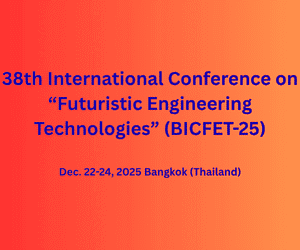
38th International Conference on “Futuristic Engineering Technologies” (BICFET-25)
Part of the International Conference on “Futuristic Engineering Technologies” (BICFET-25) series →
About & call for papers
Full Articles/ Reviews/ Shorts Papers/ Abstracts are welcomed in the following research fields: Track 1: Advanced Materials & Manufacturing - Additive Manufacturing & 4D/5D Printing: - Multi-material and functional additive manufacturing. - Self-assembly an… Read more
Full Articles/ Reviews/ Shorts Papers/ Abstracts are welcomed in the following research fields: Track 1: Advanced Materials & Manufacturing - Additive Manufacturing & 4D/5D Printing: - Multi-material and functional additive manufacturing. - Self-assembly and reconfigurable materials for 4D/5D printing. - Direct printing of electronics, sensors, and integrated systems. - Additive manufacturing for aerospace, biomedical, and construction. - Smart & Adaptive Materials: - Self-healing and self-sensing materials. - Responsive materials (thermochromic, electroactive, photoactive). - Metamaterials for novel optical, acoustic, and electromagnetic properties. - Bio-inspired and biomimetic materials. - Nanomaterials & Nanotechnology in Engineering: - Graphene, carbon nanotubes, and 2D materials for enhanced properties. - Nanocomposites and nanocoatings. - Applications in energy, electronics, and biomedicine. - Sustainable Manufacturing: - Circular economy principles in material design and production. - Green chemistry and sustainable process engineering. - Resource efficiency and waste valorization in industrial processes. Track 2: Artificial Intelligence & Autonomous Systems - AI for Engineering Design & Optimization: - Generative design and AI-driven concept generation. - Topology optimization and material-aware AI design. - AI for multi-objective optimization and complex system synthesis. - Robotics & Autonomous Systems: - Collaborative robotics (cobots) and human-robot interaction. - Soft robotics and bio-inspired robotics. - Swarm intelligence and multi-robot systems. - Autonomous vehicles, drones, and unmanned systems (perception, navigation, control). - Robotics for extreme environments (space, deep sea, disaster response). - Predictive Maintenance & Digital Twins: - AI-powered prognostics and health management (PHM). - Real-time digital replicas for simulation, monitoring, and proactive intervention. - Digital twin applications in smart cities, manufacturing, and infrastructure. - Explainable AI (XAI) in Engineering: - Developing transparent and interpretable AI models for engineering decisions. - Trust and reliability in AI-driven autonomous systems. - AI for Materials Discovery: - Accelerated design and discovery of novel materials using AI and machine learning. Track 3: Sustainable Energy & Environmental Engineering - Next-Generation Renewable Energy: - Perovskite and quantum dot solar cells. - Advanced wind turbine aerodynamics and floating offshore platforms. - Green hydrogen production, storage, and fuel cell technologies. - Enhanced geothermal systems and hybrid energy solutions. - Sustainable energy storage (solid-state batteries, flow batteries, grid-scale solutions). - Carbon Capture, Utilization & Storage (CCUS): - Direct air capture (DAC) technologies. - Innovative sorbents and membranes for CO2 separation. - Conversion of captured CO2 into valuable products. - Water & Wastewater Management: - Advanced water purification and desalination technologies. - Resource recovery from wastewater (nutrients, energy). - Removal of emerging contaminants (microplastics, pharmaceuticals). - Environmental Remediation & Resource Recovery: - Nanotechnology and biotechnology for pollutant removal. - Waste-to-energy and waste valorization technologies. - Circular economy approaches in water and waste management. - Climate-Resilient Engineering: - Infrastructure design for climate change adaptation and mitigation. - Nature-based solutions for urban and coastal resilience. Track 4: Biomedical & Bio-Engineering - Bioprinting & Tissue Engineering: - 3D bioprinting of organs, tissues, and scaffolds for regenerative medicine. - Personalized implants and prosthetics. - Brain-Computer Interfaces (BCI) & Neuroengineering: - Direct neural interfaces for control, communication, and therapy. - Neural prosthetics and brain-inspired computing. - Synthetic Biology & Genetic Engineering: - Designing biological systems for specific functions (e.g., biosensors, biofuel production). - Gene editing technologies (CRISPR) for therapeutic and industrial applications. - Advanced Medical Devices & Diagnostics: - Wearable health monitoring systems and point-of-care diagnostics. - Miniaturized surgical robots and interventional devices. - Nanomedicine for targeted drug delivery and imaging. Track 5: Space, Infrastructure & Quantum Engineering - Space Engineering & Exploration: - In-Situ Resource Utilization (ISRU) for lunar and Martian missions. - Advanced propulsion systems (nuclear thermal, electric, breakthrough concepts). - Space habitats and life support systems. - Autonomous space robotics and AI for deep space missions. - Smart Infrastructure & Urban Systems: - IoT-enabled infrastructure monitoring and management. - Resilient and sustainable urban planning with smart technologies. - Future of transportation (hyperloop, aerial mobility, smart traffic management). - Quantum Engineering: - Engineering quantum devices for computing, sensing, and communication. - Quantum-resistant cryptography and secure communication. - Quantum metrology and sensing for ultra-precision measurements. Track 6: Cross-Cutting Themes & Societal Impact - Cyber-Physical Systems (CPS) & IoT in Engineering: - Security, privacy, and reliability of interconnected engineering systems. - Industry 4.0/5.0 implementation and challenges. - Extended Reality (XR) in Engineering: - VR/AR/MR for design, simulation, training, and remote collaboration. - Ethics & Governance of Futuristic Engineering: - Responsible innovation and societal implications of emerging technologies. - Regulatory frameworks and policy for advanced engineering. - Addressing the environmental footprint of new technologies. - Human-Centered Design in Engineering: - Ergonomics and user experience for complex systems. - Designing for accessibility and inclusivity in future technologies. - Interdisciplinary Engineering Education: - Preparing the next generation of engineers for complex, interdisciplinary challenges. - New pedagogies and tools for teaching futuristic engineering concepts.
Venue
41 Sukhumvit Road Soi 4, Klongtoey, Watthana, 10110, BANGKOK – THAILAND
Bangkok, Thailand
Open ibis Bangkok Sukhumvit 4 in maps ↗The address is as the organizer gave it, and it is not checked against a map.