Engineering & Technology · Industrial & Manufacturing Engineering
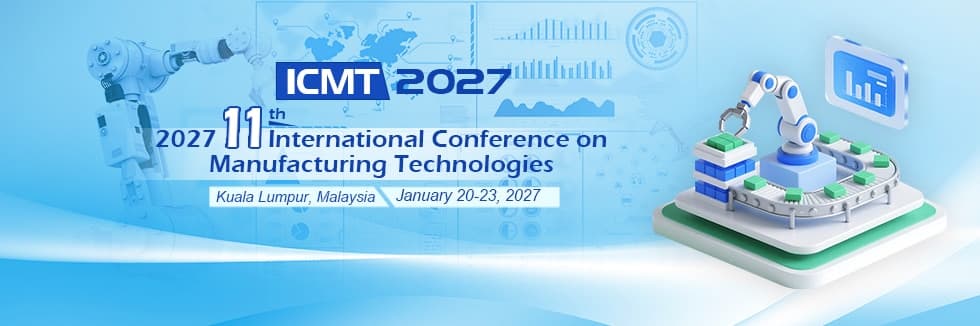
11th International Conference on Manufacturing Technologies (ICMT 2027)
Recurring
Call for papers/Topics All Abstracts, Reviews, short articles, Full articles, Posters are welcomed related with any of the following research fields: Foundational & Independent Topics These disciplines have their own dedicated theories, mathematical models, and core principles before they ever interact with one another. 1. Advanced Robotics Engineering The science of designing, coding, and building machines capable of executing tasks autonomously or semi-autonomously. - Kinematics and Dynamics: Forward/inverse kinematics, trajectory generation, and the physics of robotic movement. - Control Systems: PID controllers, adaptive control, and closed-loop feedback mechanisms for precise motor movements. - Sensors and Machine Vision: Optical character recognition (OCR), depth sensing, LiDAR, tactile sensors, and spatial mapping. - Actuation and Locomotion: Hydraulics, pneumatics, piezoelectric actuators, bipedal walking algorithms, and drone flight dynamics. - Human-Robot Interaction (HRI): User interfaces, voice command processing, and ergonomic robotic design. 2. Core Manufacturing Engineering The transformation of raw materials into finished, dimensionally accurate goods. - Subtractive Manufacturing: Advanced CNC machining, laser cutting, waterjet cutting, and electrical discharge machining (EDM). - Additive Manufacturing: Direct metal laser sintering (DMLS), stereolithography (SLA), and material extrusion. - Materials Science and Metallurgy: Heat treatment, composite material curing, polymer science, and material stress testing. - Metrology and Inspection: Non-destructive testing (NDT), ultrasonic inspection, surface roughness profiling, and laser scanning. 3. Automobile Engineering & Design The specific science of designing, powering, and packaging ground vehicles. - Vehicle Dynamics and Chassis: Suspension tuning, roll centers, steering geometry (Ackermann steering), and tire slip angles. - Internal Combustion Powertrains: Thermodynamics, fluid mechanics of intake/exhaust, fuel injection mapping, and variable valve timing. - Aerodynamics and Thermal Management: Boundary layers, drag reduction, wind tunnel simulation, and engine cooling loops. - Noise, Vibration, and Harshness (NVH): Acoustic dampening, harmonic balancing, and isolation of cabin vibrations. Interrelated & Integrated Topics When you pull these three fields together, you get the modern industrial ecosystem. This is where the most rapid innovation is happening today. 1. Industrial Automation (Robotics + Manufacturing) Using robotics to make manufacturing faster, safer, and more precise. - Collaborative Robots (Cobots): Force-limited robotic arms designed to work safely alongside human operators without cages. - Flexible Manufacturing Systems (FMS): Assembly lines that can be instantly reprogrammed to produce different parts without physical retooling. - Automated Material Handling: Conveyor logic, Automated Storage and Retrieval Systems (ASRS), and factory-floor logistics. - Machine Tending: Robots programmed to load raw materials into CNC machines and remove the finished parts. 2. Automotive Production Tech (Automobile + Manufacturing) The highly specific, scaled techniques used to build cars. - Body-in-White (BIW) Assembly: The robotic welding and riveting of the bare metal vehicle frame. - Giga-Casting: Injecting molten aluminum into massive, house-sized molds to create a car's entire front or rear subframe in one piece (replacing dozens of welded parts). - Automotive Paint Technologies: E-coating for rust prevention, robotic atomized spray painting, and UV curing. - Lean Assembly and JIT: Synchronizing supply chains so parts arrive at the factory exactly when the assembly line needs them. 3. Smart Mobility and Autonomy (Automobile + Robotics) Turning the automobile into a highly advanced, moving robot. - Advanced Driver Assistance Systems (ADAS): Radar-guided cruise control, automatic lane keeping, and collision avoidance algorithms. - Sensor Fusion: Software that stitches together camera, radar, and LiDAR data to create a 3D understanding of the car's surroundings. - Drive-by-Wire Systems: Replacing physical steering columns and brake cables with electronic sensors and robotic actuators. - Robotic Vehicle Testing: Using automated rigs to drive cars on dynamometers or slam doors millions of times to test durability. 4. Industry 4.0 (The Nexus of All Three) The complete digitization of the physical engineering world. - Digital Twins: Creating a perfect 3D digital simulation of a car or a factory to test changes in software before building them in the real world. - Predictive Maintenance: Using IoT (Internet of Things) sensors to monitor the vibration of a manufacturing robot to predict when it will break down. - Cyber-Physical Systems: Networks where the software, the physical robots, and the automotive products communicate with each other in real-time.
Closing dates are Anywhere on Earth (AoE) unless the organizer stated otherwise.
Rome, Italy
Open University of Washington Rome Center in maps ↗No street address is on file for this listing — what the organizer gave is above. Suggest the venue address →
Engineering & Technology · Industrial & Manufacturing Engineering
Recurring
Engineering & Technology · Industrial & Manufacturing Engineering
Recurring
Engineering & Technology · Industrial & Manufacturing Engineering
Recurring
Engineering & Technology · Industrial & Manufacturing Engineering
Recurring